Friday, October 31, 2014

MW Solar Blueprint


MW Solar Blueprint

Comprehensive GUIDANCE MEET for MW solar power plant developers

Saturday, Dec 6, Chennai, 9 AM – 6 PM

Organized by EAI, India’s leading renewable energy research & consulting firm

Are you an aspiring solar power plant developer?
Looking at putting up a solar power plant 1 MW or above?

Make sure you attend India’s first guidance meet for MW scale solar power plants
A full day program, Dec 6, at Chennai

Guiding you on every step of putting up a MW scale solar power plant

A day filled with step-by-step explanations and detailed answers.

This is a Guidance Session, NOT a Conference
There will be no speeches
Entire day only for extensive expert guidance and answers to questions
The entire day will be dedicated only to helping you understand the specifics of putting up high quality solar power plants
  • Data points for various aspects of a MW solar power plant
  • Checklists for MW solar power developers
  • Detailed inputs on how to calculate the right price to bid in solar tenders
  • Financing avenues
  • Recommendations on approaching banks and other financial institutions
  • Price points for the various components in a MW solar power plant
  • List of mistakes to avoid
  • Vendor selection strategy –strategy for selecting EPCs, panel and inverter vendors, and O&M vendors.
  • Site selection strategy
  • Case studies and data from existing power plants
  • Details on current and upcoming solar policies from central and state governments

A Must Attend Event for Solar Power Plant Developers

Remember, you will be investing tens of crores on a long term, 25 year asset.
It is critical to know from experts how best to go about this investment.
By spending just one day at this guidance meet, you will be able to understand the critical aspects to:
Implement a high quality solar power plant
At the best possible cost
Avoid costly mistakes

Specific Topics that will be Covered in the Guidance and Q&A Sessions

Returns & Risks

  • How attractive is an investment in MW scale solar power plant?
  • How attractive are my returns under various scenarios – with and without accelerated depreciation benefits, under various government policies and tenders
  • What are the risks involved in investing in solar power plants?

Steps Required

  • What are the first steps required to start off work?
  • Where can you find more information about solar policies of central and state governments?
  • How do I calculate my financial returns from my solar power plant?

Choosing Land, Vendors & Components

  • How can I choose the best vendor and components for the solar power plant to give highest returns over 25 years?
  • What are the various components in a solar power plant?
  • What are the price points for the various components in a solar power plant – the solar panels, inverters, mounting structures, installation cost, evacuation cost?
  • How do I choose my EPC for the solar power plant?
  • Can I use imported solar panels or is it better to purchase these from Indian manufacturers?
  • Should I go for large and prominent EPCs or small EPCs?
  • How do I choose the most suitable land for my solar power plant?
  • What about operations & maintenance of a MW scale solar power plant? Who will do this?

Business Models for MW Solar Power Plants

  • Is it a good idea to go for solar power plants under REC schemes?
  • Is it a good idea to go for solar power plants as a captive user?
  • Is the third party sale route for solar power plants an attractive option?
  • How viable are the current and upcoming solar policies from central and state governments?

Financing Options for MW Solar Power Plants

  • What are the practical financing options available for MW scale solar power plants?
  • What are the steps I should take before I approach banks and other funding agencies?
  • Which are the banks that are financing solar power plants?
  • Which are the non-banking financial institutions financing solar power plants?
  • What are the typical terms for solar power plant financing?
  • What are the options to get financing at interest rates lower than the prevailing interest rates?

Others

  • We will also be inviting questions from the participants prior to the event, and address these questions and concerns in detail.

Registration

Fee: Rs 13,000 plus service tax
Seat allotted on a First Come First Served Basis
For more details and to pre-register,
Talk to Muthukrishnan, 9952910083, events@eai.in. Please include MW Solar Blueprint in Subject of email.
Wish to pay online?
.


Wednesday, October 29, 2014

India’s Largest Canal-Top Solar PV Plant To Come Online in Gujarat


Indian Prime Minister Narendra Modi’s love for solar is more than evident from the (fun) fact that he chose to lay the foundation stone for this 10 MW canal top project on 14 February 2014! Talk about SolarLove. :D
When a 1 MW solar power plant came up on top of Narmada canal in Gujarat in 2012, it was very well received. The pilot project was developed on a 750-m stretch of the canal by Gujarat State Electricity Corporation (GSECL) with support from Sardar Sarovar Narmada Nigam Ltd (SSNNL), which owns and maintains the canal network. Both are public entities.
Two quantifiable benefits of building solar power plants on canals as against conventional ground-mounted systems were widely reported — the amount of land it would save and also the amount of water it would save, which would have otherwise been lost due to evaporation. Both excellent points.
The capacity utilization factor works out to be around 18%, which should be easily achievable in Gujarat.
The only problem with the project was its high cost. At the time, it came up it cost $2.9 million for 1 MW, about 50% more expensive than a conventional ground mounted solar plant, and was criticised by some. But then, small-scale pilot projects have always been expensive.
About a year back, Mridul reported on the intentions of the Gujarat government to develop a second 10 MW canal-top solar power plant. As per recent news, installation of this 3.5 km long solar plant has now been completed and it is expected to come online anytime. The project took about eight months for completion.
The 10 MW canal top solar power plant has been installed in the city of Vadodara, over a branch of Narmada river canal. The EPC was handled by the Hyderabad-based Megha Engineering and Infrastructure Limited (MEIL). The total capital cost of the system has been about $15 million. MEIL will also be responsible for O&M of the solar power plant for 25 years which would cost another $1.6 million.
The plant will generate more than 16 million units a year, and will help reduce SSNNL’s dependency on state utility. The electricity generated will be used to power five pumping generators situated along Saurashtra branch canals to draw water and supply them for irrigation. It is expected that the cost of electricity would be in the region of Rs.7/kWh (about 11 cents per unit).
SSNNL also plans to build public gardens around the installation site, so that locals can relax and also be a witness to the marvels of clean energy generation!
http://cleantechnica.com/2014/10/28/indias-largest-canal-top-solar-pv-plant-come-online-gujarat/

Friday, October 17, 2014

To power the entire world, it would take an area of just 158 squared miles of ‎solar‬ panels.


To power the entire world, it would take an area of just 158 squared miles of ‪#‎solar‬ panels.

Read more: bit.ly/1nTCbFR

Friday, October 10, 2014

4 MW - Solar Power Plant at Vellakoil Karur district installed by Srinivas Mohan and Team

About 18000 Kg of CO2/day emission reduced by the Solar Power Plant, which is equivalent to develop and maintain 11,14,183 trees per day, think about nature, proud to be an solar developer


Single Axis Solar installation


Srinivas Mohan - Connect with us on Facebook

https://www.facebook.com/srinivas.vimal?fref=ts

Srinivas Mohan - Ph no: 9952816880 (For solar consultation, Remote monitoring systems)

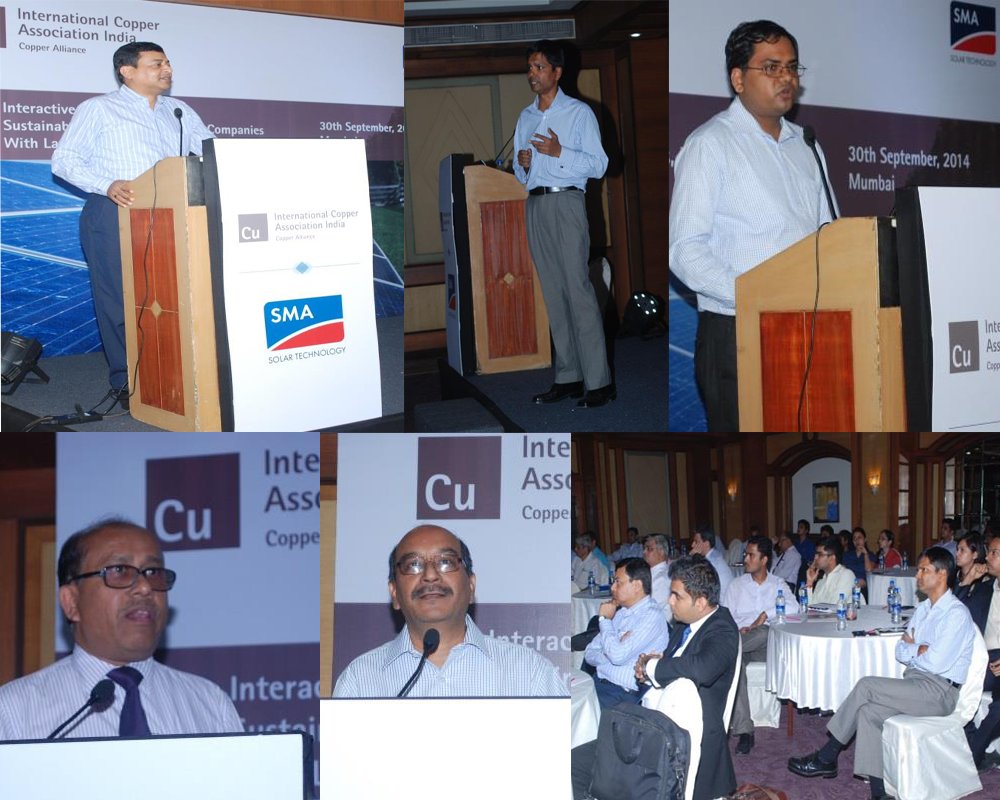
ICAI Organizes a Workshop on ‘Sustainable Solar Solutions for Companies with Large Energy Needs

Mumbai, October 1, 2014 — International Copper Association India (ICAI), a part of Copper Alliance in association with SMA India organized a special workshop on ‘Sustainable Solar Solutions for companies with large energy needs’ in Mumbai. The objective of the seminar was to create awareness for facilitation of faster decision making towards Solar Power Systems in India.
This workshop was addressed by a panel of dignitaries comprising Mr. Sanjeev Ranjan, Managing Director, ICAI, Mr. Virendra Kumar Gupta, Chief Manager, Renewables ICAI, Mr. Piyush Kumar, SMA-India and Mr. Vinay Rustagi, Managing Director, Bridge to India. The event witnessed a large gathering from solar system & component manufacturers, solar system integrators and other industrial units across India who actively participated in the interactive sessions.
Untitled-3
India is currently facing a major challenge of power shortage which is invariably affecting the production targets and interrupting continuous manufacturing processes. The cost of power back up systems, mainly the diesel generators varies from Rs.15/- to Rs. 30/- per unit. However, with technological advancement, this can be drastically reduced to Rs 7/- per unit with use of solar power. According to a recent research by International Energy Agency (IEA), solar power could become the world’s largest source of electricity by 2050 as the solar photovoltaic plants may provide around 16% of global electricity. The report also states, that the explosive growth in solar installations will be driven by further price drops. The cost of electricity from photovoltaic projects will fall by an average 25% by 2020, 45% by 2030 and 65% by 2050.
Commenting on this occasion, Mr. Sanjeev Ranjan, Managing Director, ICAI said, “Maharashtra is home to vast range of industrial establishments starting from micro units to very large units. It is imperative to have a steady power backup for such units. With the new government’s plan to provide 24*7 electricity supply, solar energy offers technologically feasible & economically viable alternative. The modular concept helps to design solar power plants to meet tailor made requirements of all sizes of industrial units. This further benefits to increase overall production efficiency and automating the standard processes thereby reducing cost-per-unit”.
The workshop also highlighted latest trends in Solar PV technologies along with the regulatory framework supporting solar energy in India. International Copper Association India (ICAI) has been very active in the field of promotion of Energy Efficiency & Renewable Energy.
About ICAI – The International Copper Association India (ICAI) is a member of Copper Alliance and the Indian arm of the International Copper Association Limited (ICA), the leading not for profit organization for the promotion of copper worldwide set up in 1959. The objective is to “Defend and grow markets for copper based on its superior technical performance and its contribution to a higher quality of life worldwide”. ICA India conducts various programs in the interest of Electrical Safety, Energy Efficiency and Sustainability.
For more information contact:
Mr. VK Gupta, ICAI
Mobile: +919766696516
Email: virender.gupta@copperalliance.asia
- See more at: http://www.eai.in/news-and-media/pr/international-copper-association-india-icai-organizes-a-workshop-on-sustainable-solar-solutions-for-companies-with-large-energy-needs#sthash.Me8lMQCd.dpuf

Wednesday, September 3, 2014

Long way to go for rooftop solar systems


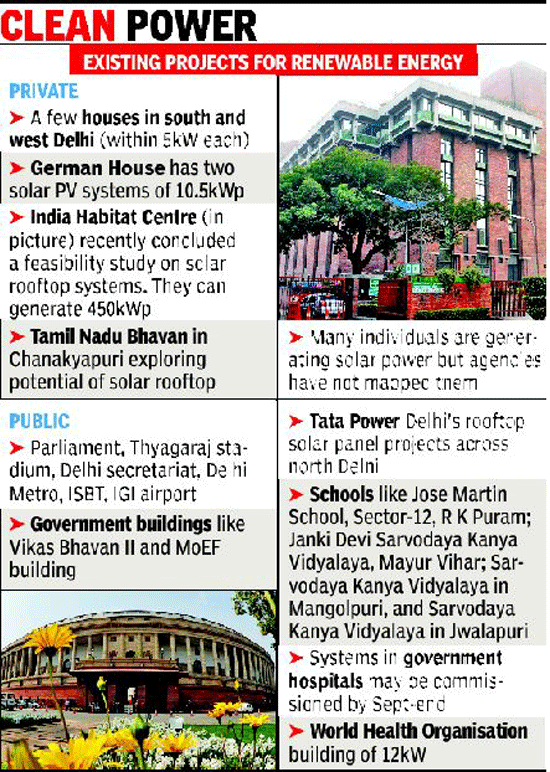
NEW DELHI: Delhi government still has a long way to go in clarifying the policy before private individuals take the decision to set up rooftop solar systems. The net metering scheme that was announced by the Delhi Electricity Regulatory Commission (DERC) on Tuesday is only a nascent step in this direction.

The most important issue is the financial incentive that will push residents to invest in solar rooftop systems. Other problems are resolving technical issues like uneven height of houses, specifications for orientation of the roof, how much roof space is required, how will these systems be maintained, among others.

"We are glad to know that net meters can be installed and we are open to setting up such systems. But the question is what is in it for us? First the government will have to clarify how much subsidy and what financial incentive will be given to individuals. It must also check whether it is feasible to do these on small rooftops of less than 200 sq yards," said Atul Goel, convenor of United Residents Joint Action of Delhi who had some meetings with Greenpeace, an environmental NGO studying whether Delhi can implement solar rooftop systems on a large scale.

As of now, projects in Delhi only get a 30% subsidy from the ministry of new and renewable energy (MNRE).


"It's a welcome move that DERC has finally come up with a net metering policy. But how can people use it without a comprehensive solar policy which will specify financial incentive in detail? Only if the incentive is attractive that people would think about it. As of now, a few individuals in Delhi have set up rooftop solar panels to meet their back-up needs because diesel generators cost a lot," said Abhishek Pratap, energy campaigner at Greenpeace India.

The few who have already installed solar panel systems may, however, stand to benefit immediately from the net metering scheme. Anand Prabhu Pathanjali, who recently conducted a study on Delhi's solar potential, said, "There are very few residences that have set up such systems. Now they can definitely benefit from the net metering scheme. This will also get more people to set up the system in their houses."

There are a few houses in South Extension and Safdarjung Enclave, apart from a few others in West Delhi that have installed solar panels of less than 5kW. The German House of Research and Innovation and WHO building also have panels with over 10 kilowatt peak (kWp) capacity that can benefit from net metering.

The Energy and Resources Institute (TERI) is planning to install a system of less than 100 kWp on their office building. "We don't have much space so we are exploring what can be done. However, we'll probably not generate enough to have more power than our requirements. On weekends we can supply entirely to the grid," said Amit Kumar, adjunct professor, TERI University.

Wednesday, August 27, 2014

Indian Renewable Energy Company Welspun Plans $2.5 Billion Investment Over Next Three Years

Welspun Solar Project Madhya Pradesh

Indian renewable energy companies are preparing for long-term investments as the new government gets ready to introduce favorable regulatory initiatives to expand renewable energy infrastructure.
One of India’s leading renewable energy companies, Welspun Group, has announced plans to invest Rs 15,000 crore –  or $2.5 billion US – to develop wind and solar power capacity over the next three years. The group hopes to have an installed renewable energy capacity of 1.75 GW by the end of the next three years. So far, the group has installed 330 MW capacity, while 750 MW capacity is under development.
The group will continue to invest heavily in the development of solar power capacity; it also expected to install about 120 MW of wind energy capacity by March of next year. The company will invest in Andhra Pradesh, Maharashtra, Punjab, and Rajasthan to develop solar power projects.
Earlier this year, Welspun Energy commissioned Asia’s largest solar power project. The 151 MW that required an investment of $177 million is located in the central state of Madhya Pradesh, and started generation around February this year.
The project attracted $24 million investment from GE Energy Financial Services earlier this year. Welspun Energy had taken debt worth $150 million for implementing this project, and the equity investment made by GE Energy Financial Services will be used to pay off a portion of the debt.
More recently, the Asian Development Bank had invested $50 million to pick up 13.3% equity stake in a subsidiary of Welspun Energy, Welspun Renewables Energy Limited. The company will use this investment to add more than 250 MW of renewable energy capacity by March 2016.
The company may take additional measures to raised funds to finance the implementation of the envisaged capacity. For this purpose the Asian Development Bank may assist the company to launch an initial public offer.
Keep up to date with all the hottest cleantech news by subscribing to our (free) cleantech newsletter, or keep an eye on sector-specific news by getting our (also free) solar energy newsletter, electric vehicle newsletter, or wind energy newsletter.